The first stage of this Explorers’ Route with my favorite photographer and my dad (remember, I explained everything in a previous article) was the Laurentides province. This destination is well-known to Quebecers, and particularly to Montrealers, since it is located just north of the city of Montreal and is therefore a very popular vacation spot for them throughout all 4 seasons of the year. It is especially popular with cyclists in the summer and skiers in the winter.
For our part, when we passed through the Laurentides, it was the very beginning of the fall foliage season, also called “Indian summer” by Quebecers, which is one of my favorite times of the year there. The Laurentides are teeming with parks and wildlife reserves, making it a rather natural territory with wide-open spaces, mountains, lakes, and forests.
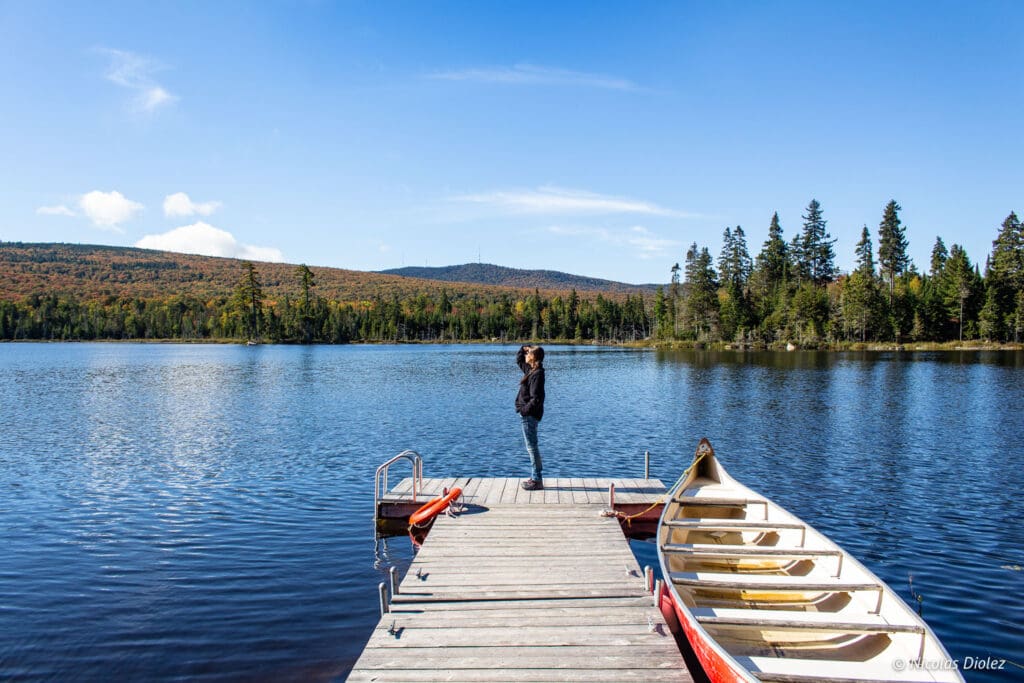


In terms of gastronomy, you will also be spoiled with good local products, especially those featuring maple, but not only that, and some great regional microbrewery addresses that I strongly encourage you to discover if you are a beer lover. I will organize this article geographically, talking to you chronologically about all the stages we took on this Explorers’ Route, giving you a selection of good spots tested on-site and ideas for things to do, as I usually do.
_
Table of Contents
Our video on the Laurentides
Here is a short video made by my favorite photographer, which presents our time in the Laurentides region specifically.
As in the first article, I have included a map below so you can visualize our itinerary and the different stages of our road trip.
Addresses
- Vieux Saint-Eustache — Saint-Eustache, QC, Canada
- Vignoble Rivière du Chêne — 807 Chemin de la Rivière N, Saint-Eustache, QC J7R 0J5, Canada
- Labonté de la Pomme — 405 Rang de l'Annonciation, Oka, QC J0N 1E0, Canada
- Hôtel et Spa Mont-Gabriel — 1699 Ch du Mont-Gabriel, Sainte-Adèle, QC J8B 1A5, Canada
- Baril Roulant — 1430 Rue de l'Académie, Val-David, QC J0T 2N0, Canada
- Scandinave Spa Mont-Tremblant — 4280 Montée Ryan, Mont-Tremblant, QC J8E 1S4, Canada
- Gare de Labelle — 180 Rue du Dépôt, Labelle, QC J0T 1H0, Canada
- Pont couvert Macaza — La Macaza, QC J0T, Canada
- Gare de l'Annonciation — 682 Rue L'Annonciation N, Rivière-Rouge, QC J0T 1T0, Canada
- Hôtel du Mont-Tremblant — 1900 Chemin du Village, Mont-Tremblant, QC J8E 1K4, Canada
- Parc Montagne du Diable — Parc régional Montagne du Diable, Village des Bâtisseurs, 1100 Chemin Léandre Meilleur, Ferme-Neuve, QC J0W 1C0, Canada
_
Stage 1: The Deux-Montagnes County, Laurentides
Located in the Lower Laurentides region and more specifically in the northern crown of Montreal, this Deux-Montagnes county is quickly accessible from Montreal (only about twenty kilometers away).
The region is also famous for Oka cheese, and if you are in the area, I advise you to take the Oka-Hudson ferry (which has existed since 1909) on board a ferry that allows you to cross with your car from Oka to Hudson (in Montérégie) in 10 minutes on the Lake of Two Mountains. Once on the other side, if you are looking for a sugar shack address (where you will find plenty of products made with maple syrup), I recommend the Sucrerie de la Montagne, which is a very nice place.


_
Sightseeing in Old Saint-Eustache
This small town is located on the site of the village established in the 18th century and was the site of the Patriots’ Rebellion of 1837, an important historical moment for Quebec. A visit to Old Saint-Eustache allows you to discover more than 40 buildings and sites, witnesses to the history of the city’s development in the time of the first builders. You can either pick up information and brochures at the Maison de la Culture et du Patrimoine and wander around on your own, or you can also follow tours and circuits commented by a guide (inquire at the Maison de la Culture et du Patrimoine).


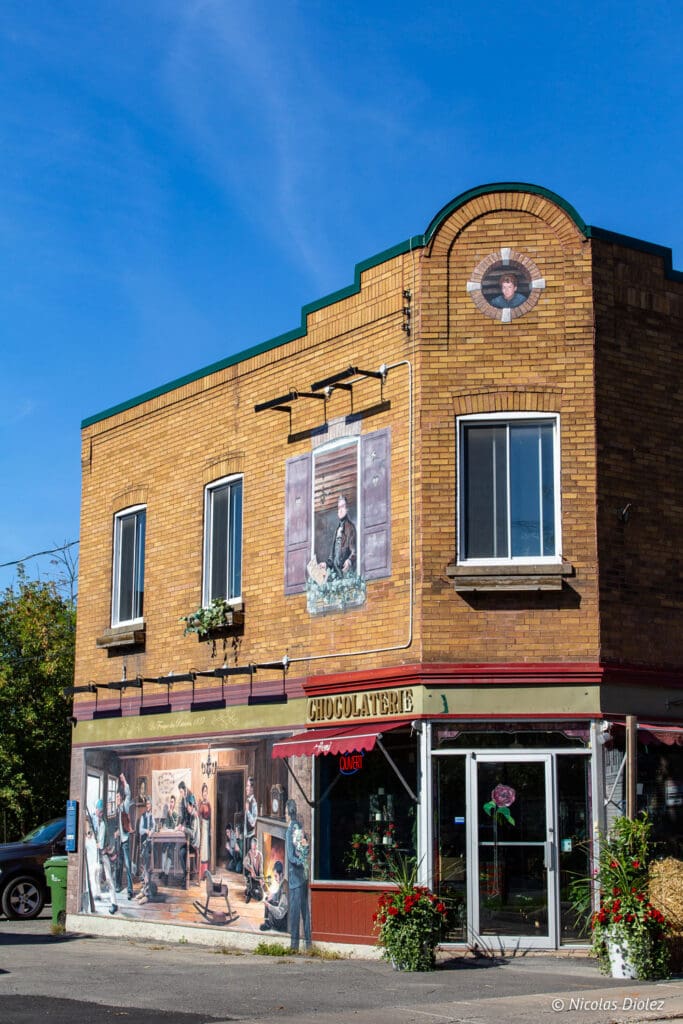


Also take advantage of your visit to the Maison de la Culture et du Patrimoine to visit the exhibitions offered by the venue to learn more about the Patriots and the events related to this important moment in Quebec history. And in particular by discovering the free permanent exhibition “The 1837 Rebellion in the Deux-Montagnes County”.

I also advise you to take a tour of the Moulin Légaré (232, rue Saint Eustache) to discover its history, but also to understand the production of wheat and buckwheat flour (you can also buy some on-site). It is also the oldest flour mill still in operation in North America, having been active since 1762.


Old Saint-Eustache Maison de la Culture et du Patrimoine (Manoir Globensky) 235 rue Saint- Eustache, Saint-Eustache, QC J7R 2L7 Adult visit to Moulin Légaré $7 / free for children under 6
_
Where to eat? Lunch at Labonté de la pomme
This family agritourism estate offers a fruit and bee farm as well as a restaurant and is located on a mountainside, overlooking the beautiful Oka Valley. People come here to harvest the farm’s fruits (25 different varieties) through U-pick, an activity that Quebecers love, or simply to come and feast in the apple shack, where products are cooked in a wood-fired oven.


We enjoyed a meal made with products from the region on this occasion, and I think we overdosed on maple syrup right from the start of our stay!!! But it is truly the perfect place to taste traditional and rustic Quebec cuisine.
To taste: the country-style waffle with maple bacon and Oka cheese between 2 waffles ($17.50); the estate’s special onion soup ($10); shack-style baked beans ($5.50); for a drink, the non-alcoholic sparkling apple juice is very nice; the estate’s apple pie to finish you off!


After the meal, we took a tour of the orchards with a little U-pick, of course, and then you absolutely must stop by the shop before leaving to stock up on local artisanal products. You can notably buy apples of the Mc Intosh variety (which is a local production) and they are absolutely delicious!


Labonté de la pomme 405, Rang de l’Annonciation Oka, QC J0N 1E0 (located about 35 min from Montreal)
_
Visit the Vignoble Rivière du Chêne
This vineyard was founded in 1998 by a young passionate winemaker who wanted to see what vine cultivation could produce in Quebec. Obviously, one cannot compare the wines produced in Quebec with those produced in other countries, because the development of this culture is still in the experimental stage and winemakers are still doing a lot of testing to try to determine which grape varieties adapt best to the country’s climate.
The idea is therefore not to compete with what already exists, but to seek to do something typical and original that is faithful to the spirit of Quebec, and that is the reason why, as a French wine lover (and curious by nature, I must say), I found the visit to this vineyard particularly interesting. You can discover this place during a tour of the estate or simply through a tasting of its products.


My recommendations: the ice wine (a type of late harvest with grapes that have frozen); the maple wine (very original).
Vignoble Rivière du Chêne 807, Chemin de la Rivière Nord Saint-Eustache, QC J7R 0J5 Tours from May to mid-October Tour price: $10 The good deal: free tasting in the shop all year round from 10:30 am to 4:30 pm
_
Stage 2: In the heart of the Laurentides
After about 1 hour of driving (after the vineyard), we begin to move away from Montreal to enter the part of the region called the Upper Laurentides, in the heart of this province.

_
Where to sleep, where to eat? Hôtel et Spa Mont-Gabriel (closed)
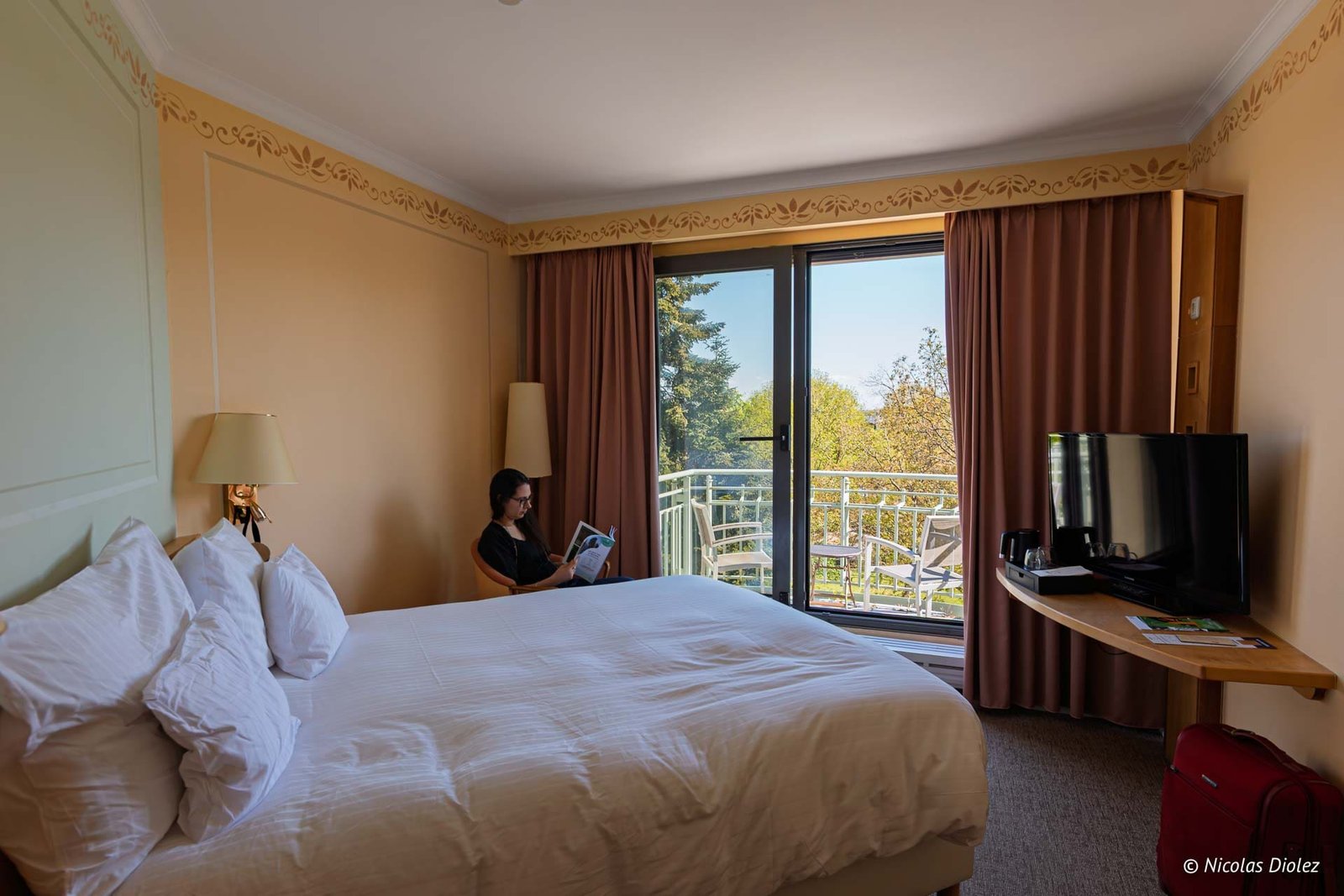
Perched in the heart of the Laurentides, 45 minutes north of Montreal, the Hôtel & Spa Mont Gabriel is a 4-star resort with 136 accommodations and offers many activities on-site for its guests. What struck us (but we found this in many hotel rooms during our trip) is this very North American habit of having rooms with two double beds, which means that two couples can easily sleep in the same room (if you are not bothered by this kind of intimacy).
Furthermore, the bedding in our room was really very comfortable and from our balcony we had a very beautiful view of the surroundings and the beautiful nature of the Laurentides. I appreciated the charm of this establishment which transported me to another era for an evening, through its peaceful and relaxing atmosphere.


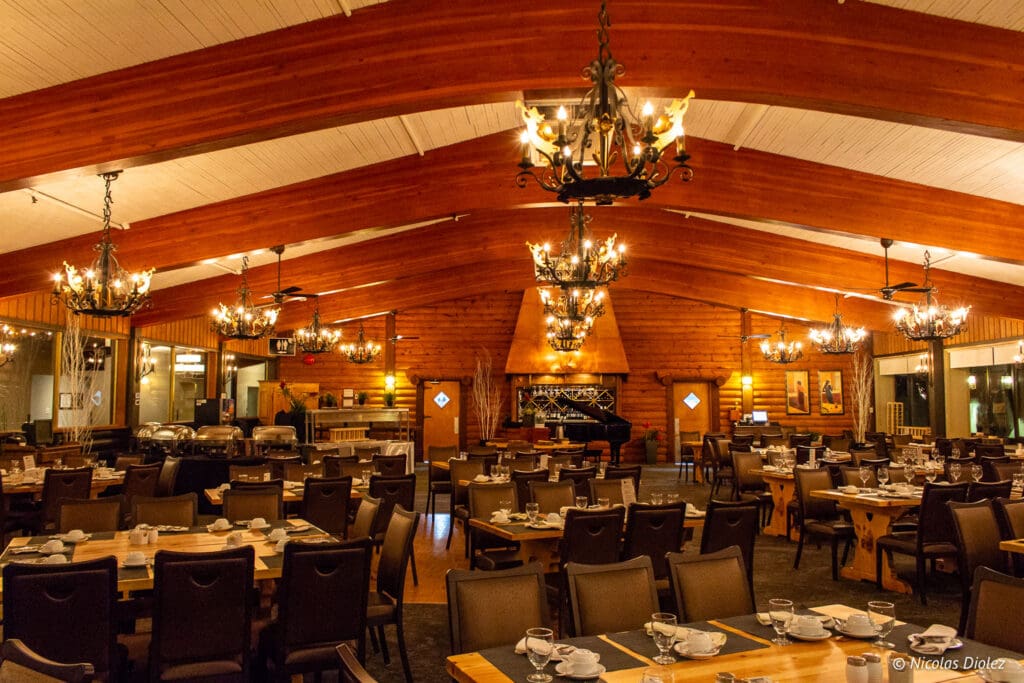
In the evening, we also ate on-site at the hotel restaurant, Ambroisie, where we enjoyed a 4-course table d’hôte menu ($42 / person) in the beautiful and large main dining room that you can see in the photo below.


The little extra: the indoor pool and the Relaxia spa with an indoor sauna for a moment of relaxation after the drive, which is very much appreciated.
Hôtel et Spa Mont-Gabriel (closed in 2026)
1699, Ch du Mont-Gabriel Sainte-Adèle, QC J8B 1A5
Rates for a regular room with two double beds: from $126 per night
_
The Village of Val-David
The Village of Val-David (a 20-minute drive from Mont-Gabriel) is surrounded by mountains and forests, and it can be a nice stop on your route to do a bit of shopping (or rather “magasinage” as the Quebecers say) because there are some lovely boutiques. For our part, we weren’t lucky; it was pouring rain during our time in the town, and we didn’t linger too long…
My advice: go grab a coffee at the Magasin Général ($2.50 for an Americano), located at 2475 rue de l’Église, because in addition to having a very nice little coffee shop corner, you’ll also find lots of great gift and decor ideas.


_
Where to eat and drink a beer? Le Baril Roulant
This festive craft microbrewery has several locations in Val-David (a pub, an inn, and the microbrewery itself). The inn where we stopped for lunch (which also offers accommodation, rooms, and a dormitory, as its name suggests) offers a large selection of craft beers (let the inn staff guide you; they will be able to advise you very well according to your tastes), local spirits, ciders, and serves some tapas to eat such as nachos, burgers, and beer waffles.
This culinary stop was also the opportunity for the favorite photographer and my dad to eat their first poutine!!! You know, that Quebec specialty with fries covered in melted cheese (or not) and a thick brown gravy, the pinnacle of Quebecois dietetics!


I also advise you to stop by the microbrewery (where the beer is handcrafted) both to visit the facilities and also to buy some Baril Roulant beers (you will see during our journey that we brought back a lot, a lot of beers in our suitcases…).
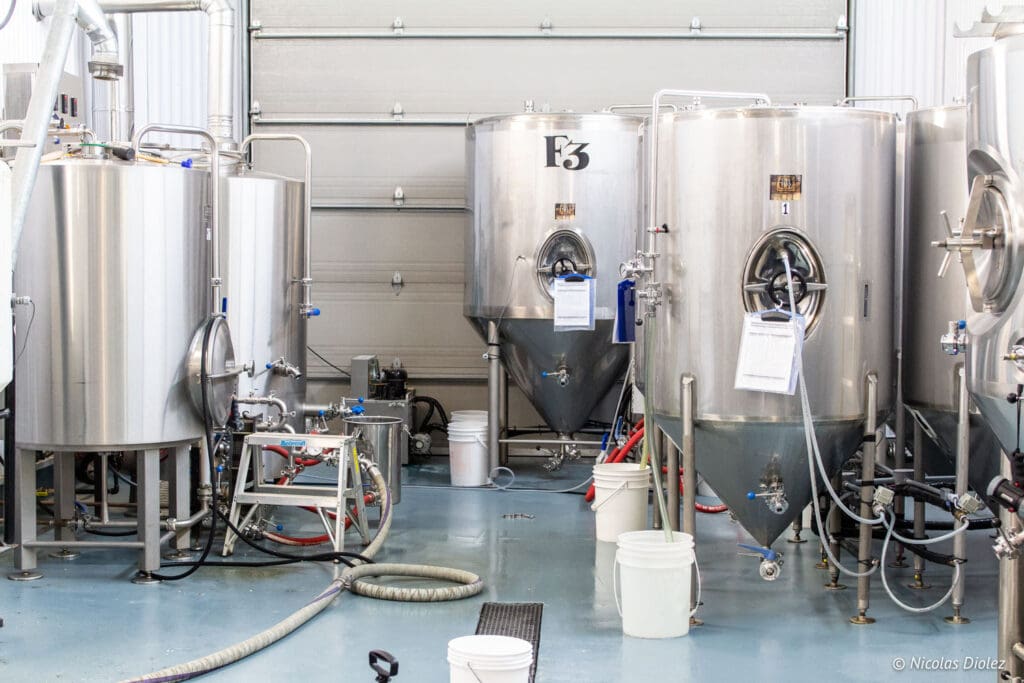


Auberge du Baril Roulant 1430, rue de l’Académie Val-David, Québec, J0T 2N0 Microbrewery: 1650, route 117 Val-David, QC
_
Step 3: Mont-Tremblant, Laurentides
The Mont-Tremblant region, nestled in the heart of the Laurentian mountains, is well known to Quebecers because it is one of the favorite vacation spots for Montreal residents, especially for skiing in the winter. This area, and all the others that we will discover later even further north, began to open up to the rest of Quebec at the end of the 19th century, with the arrival of the railway and the “P’tit-train-du-nord” (of which we will visit several stations, by the way, a little further on in the article).
For our part, we didn’t have much time to visit the resort center, but we preferred to go for a short walk along Lac Mercier (there is a trail that goes all the way around, but it’s quite long) because it was located right next to our hotel. The weather wasn’t really great, as you can see in the photos, but we really appreciated the misty atmosphere of this fickle weather.


_
Where to sleep, where to eat? Hôtel Mont-Tremblant
This small hotel is located in the village of Mont-Tremblant, right on the edge of Lac Mercier, and it has 19 rooms and an “Au Coin” restaurant-pub on the ground floor where we had dinner in the evening. We also took the opportunity to taste the Quebec cheese platter ($14.95) because, as we were able to see during our trip, there is a great production of cheeses in this part of Quebec and it would be a shame not to discover it because there are some very interesting things.


Hôtel Mont-Tremblant 1900, chemin du Village Mont-Tremblant, QC J8E 1K4 Rate: $52.50 for a standard room + breakfast
_
Relaxation at Scandinave Spa Mont-Tremblant
The Scandinave Spa Mont-Tremblant is a superb place located right next to the Rivière du Diable and offers a beautiful traditional experience of Scandinavian baths in a peaceful and natural environment. In short, the ideal place to relax along this Explorers’ Route!
The Spa opened its doors in 1999 in the heart of the Laurentian forest and expanded in 2017 with new facilities and two additional hydrotherapy circuits. For your information, hydrotherapy is an effective way to free the body from its tensions and the mind from its worries with a hot-cold-relax cycle that contributes as much to energizing the body as it does to resting it, improving blood circulation, and activating the lymphatic system to eliminate toxins. The principle of the place is simple: you get changed, you leave your phone in the locker (and yes, it is forbidden in the Spa areas), you respect the ambient silence, and you relax!!! Almost a challenge for me, as you might have guessed!


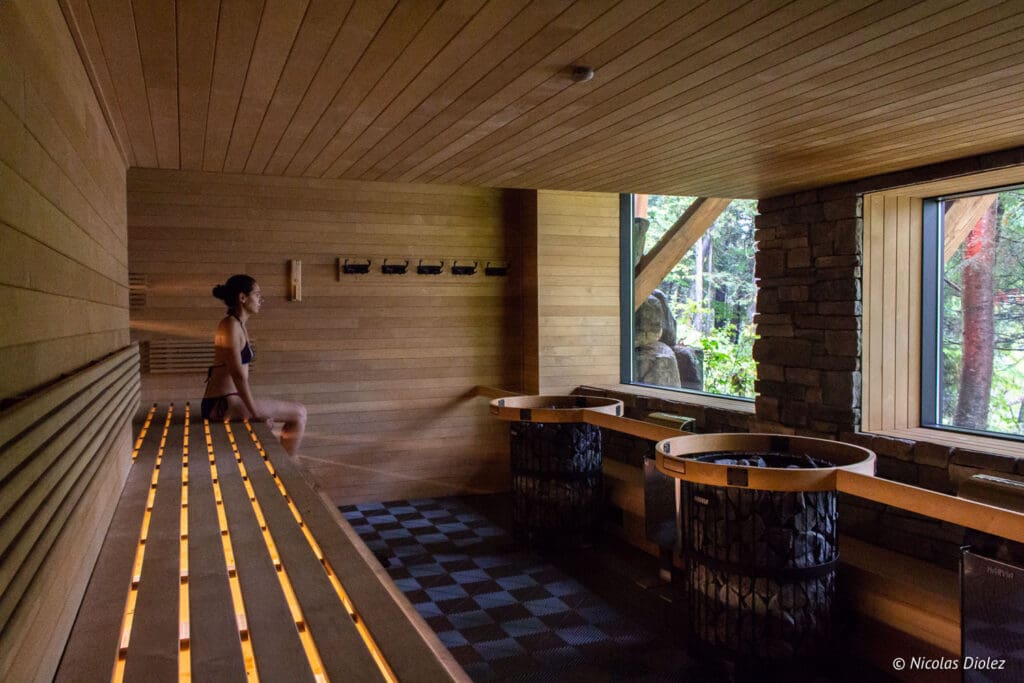


On the program: dry saunas, steam baths, hot baths, Nordic waterfalls, cold water basins, swimming in the Rivière du Diable (only for the bravest, in our case it was my dad), outdoor fireplaces, solarium, relaxation areas… If you want to spend the day on-site, the establishment even offers a small snack bar for a very practical quick meal: soup of the day ($4.99), wraps ($8.99), quiche of the day ($4.25).
Scandinave Spa Mont-Tremblant 4280, Montée Ryan Mont-Tremblant, QC J8E 1S4 Scandinave Spa rates: $60 / person for access to the site for the whole day
_
Step 4: The Route des Belles-Histoires and the P’tit Train du Nord
As I told you above, this northern region of the Laurentides began to be frequented by Quebecers starting in 1892, with the arrival of the railway and the “P’tit-train-du-nord“. Today, this former railway line, closed since 1981, has become the longest greenway in Canada and attracts a huge number of cyclists and cross-country skiers every year on what is now called the “Le P’tit Train du Nord” linear park. By following it, you discover beautiful places from heritage stations to villages.
The Route des Belles-Histoires (which is part of Quebec’s official tourist routes) extends over more than 280 km along the axis of Route 117 from Saint-Jérôme to Mont-Laurier, also following the linear park through one of the region’s colonization paths.


There is even an audio guide (practical when you are on a road trip, provided you have a car radio in your car, of course) that allows you to go into a very rural setting in the heritage stations, museums, and interactive kiosks on the route to discover local history from a new angle. That’s what we did (on a small part of the journey only, of course) and I describe below the few stops we made on this Route des Belles-Histoires.
_
Labelle Station
This station is located directly on the Le P’tit Train du Nord linear park at km 107, and you just need to take Rue Du Pont and Rue Allard to get there. On-site, you discover a bit of the history of the P’tit Train du Nord and Labelle, a municipality that would become a true railway depot with the extension of the railway to Mont-Laurier. Several vestiges of this era are still visible, such as the current station which was built in 1924 and which now serves as a restaurant and inn for cyclists passing through. It also houses a railway museum.


Labelle Station 180 Rue du Dépôt Labelle, QC J0T 1H0
_
The Macaza Covered Bridge
Built in 1904, here is a beautiful example of a “Town elaborate” type covered bridge, and it is also the only covered bridge still in place in the Rouge Valley. This little stop reminded my dad and me a lot of that beautiful Clint Eastwood film that we love very much, The Bridges of Madison County with Meryl Streep.
Since most bridges were made of wood back in the day, covered bridges were built to delay deterioration and prevent them from rotting. The entrance to these bridges resembled a barn door, which had the effect of calming the horses crossing them because they couldn’t see the water. Interesting, right?!


_
L’Annonciation Station
This station was built in 1903 and several outbuildings were added over the years, including the station master’s house in 1905, the material yard and tool sheds in 1911, and the freight and coal depots in 1924. Inside the station, you’ll find the tourist information office and a multidisciplinary exhibition center that is open year-round. It is also possible to watch a video on the history of the Antoine-Labelle RCM there.

L’Annonciation Station 682, rue L’Annonciation Nord, Rivière-Rouge, QC J0T 1T0
_
Nominingue Heritage Station
Built between 1903 and 1904, the Nominingue station is in the “ornate cottage” style. In addition to the tourist information office located in the old station’s baggage room, history buffs will be delighted as a room called the Heritage Room, located in the former station master’s office, houses a collection of objects used in the railway operations of the C.P.R., commonly known as the Canadian Pacific. A significant collection of nearly 2,000 old photos is also archived and displayed in albums accessible to visitors. You can also watch the Antoine-Labelle RCM video capsule there.

Nominingue Heritage Station 2169, chemin du Tour-du-Lac Nominingue, QC J0W 1R0
_
Where to sleep, where to eat? Gîte Le Provincialart (closed)
This bed and breakfast is run by an absolutely charming couple, Diane and Guy, who will welcome you as if you were family (hurry up and go because they told us they wanted to retire completely soon, and we can understand why) in their beautiful, century-old house that was originally a convent and a juniorate, then an orphanage.
I highly recommend that you also book dinner (that’s what we call the evening meal in Quebec), which is prepared with great talent by the hostess in 4 courses. If you want to drink a local beverage with it, Guy will take you to pick up a few things for the meal. For our part, we obviously chose to test a local beer, the Saint Arnould, brewed in Mont-Tremblant (in case you didn’t know, Quebec is truly the land of microbreweries).


In the same way, the breakfast served in the morning is also delicious, and we really enjoyed the homemade scones! If the weather permits, Guy will certainly suggest you go play a game of Disc Golf (yes, yes, this sport really exists, I assure you!) with the 18 baskets ready to play that are located in the nearby forest.


Gîte Le Provincialart (2026 update: closed)
2292, rue du Sacré Coeur Nominingue, QC J0W 1R0
_
Where to sleep in unusual accommodation: les Toits du Monde
This unusual and ecological accommodation center offers nights in treehouses, a tipi, a yurt, and a hobbit house, all built by the owners, Dior & Sylvain, a very endearing couple. We didn’t sleep there, but our host took us for a little tour of this enchanted estate in the heart of nature!


Les Toits du Monde 1777, chemin des Faucons, Nominingue
_
Step 5: The Hautes-Laurentides
This is the last stage of our time in the Laurentides, in the far north of the region, before heading off to discover Abitibi-Témiscamingue (which will be the subject of another article on the blog).

_
Montagne du Diable Regional Park
The Montagne du Diable overlooks the landscape with its many lakes and it is also the 2nd highest peak in the Laurentides after Mont-Tremblant, which I mentioned earlier.
Upon arriving at the park, I advise you to go through the Léopold-Papineau reception pavilion, first to pay your entrance fees (yes, parks charge fees in Quebec, but they are also extremely well maintained) and also to find all the information on activities to do in the park with hiking trails, as well as restrooms (yes, yes, it’s super important, I assure you!).


There are many walking trails in this park (about 80 km of trails) for hiking, and we were lucky enough to discover a small part of them with our charming guide, Andréane. The park also has log cabins where you can spend the night for a more immersive experience. Another fun activity I recommend you do is to rent a canoe-kayak to go paddling and tour the Montagne lake.


Montagne du Diable Park Village des Bâtisseurs 1100, Chemin Léandre Meilleur Ferme-Neuve, QC J0W 1C0 Regional park entrance fee for 1 day: $7 per person / free for under 18s open 7 days a week from 9 a.m. to 5 p.m.
_
Where to eat, where to drink a beer? Microbrasserie du Lièvre
The closest town to the Montagne du Diable regional park is Mont-Laurier and it is also the regional capital of the Hautes-Laurentides. I advise you to go there before or after your day at the park to eat, and for that, I recommend you stop at the Microbrasserie du Lièvre, which will allow you to taste a new craft beer from the region!
The establishment also offers a pub-style restaurant that highlights the region’s producers and artisans as well as their local products. For my part, I warmly recommend you taste the house specialty: the homemade smoked trout plate ($16 for a starter portion and $24 for a main portion). Otherwise, the poutine with pulled smoked meat is also worth trying (£11 or £15 depending on the size, and for information, the small size is often more than enough for us Europeans).


Microbrasserie du Lièvre 131, Boul. A.-Paquette Mont-Laurier, QC J9L 1J2 Beer prices: glass from $6 and from $20 for a pitcher
_
Thanks to Québec Original for this opportunity and to the Laurentides region for hosting us and for this great program!
I hope that with all this, I will have made you want to discover or rediscover Quebec and the Laurentides region, and if you also have your own tips for this destination, don’t hesitate to share them in the comments!

Find all my articles on Quebec below
(3 trips in 2010, 2013 and 2018):
⇒ All my articles on Quebec
GENERAL INFORMATION ON QUEBEC
⇒ Quebec: practical info, how to get there, general information on Montreal
MY STOPS IN QUEBEC
⇒ Gaspésie
⇒ Montreal
⇒ Quebec City
⇒ The Laurentides
⇒ Abitibi-Témiscamingue
⇒ Outaouais
Photo credits: Nicolas Diolez
Photos are not royalty-free, photographer's authorization required before any use