Even though Mademoiselle Bon Plan is the blog of a Parisian at heart, we don’t hesitate to stretch our legs outside the capital.
This month, I am taking you to Nantes to meet the Nîmes-born artist Claude Viallat. Then, we head to Nogent-sur-Marne to discover the work of a young Thai artist. From there, we will head to Beauvais, where an exhibition is being held on a little-known French painter from the interwar period. I will then take you to an old Cistercian abbey in the Val-d’Oise converted into a contemporary art site. Finally, back to Paris, with an exhibition on graffiti and an announcement about a Montreal festival arriving for the first time at the Cité de la Mode et du Design.
In short, this post, in addition to sharing our cultural favorites, is also an opportunity to brush up on your geography.

_
Table of Contents
Claude Viallat at the Musée des Beaux-Arts in Nantes
From one port city to another… During the 1988 Venice Biennale, Claude Viallat chose sails as the medium for his works. About thirty years earlier, in 1965, he created La Vague (The Wave), a tribute to Matisse. The Rhône, the Camargue, and the Mediterranean are environments the artist knows well and from which he recovers discarded items: driftwood, ropes, and netting elements.
It was therefore quite natural that the Musée des Beaux-Arts in Nantes, which also holds two works by Claude Viallat in its collection, turned toward the theme of the sea. Sails, ropes, nets, parasols… the exhibition brings together around thirty works from 1965 to 2015.


Claude Viallat confronts the space of the Chapelle de l’Oratoire, which has been converted into an exhibition space since the 1990s. A gigantic sail placed diagonally topped with a net, two vertical elements: the main lines are set.
Objects arranged in triangulation catch the eye. The artist also invites us to a dialogue with the decorative elements of the chapel.
 On the walls, Viallat has placed unstretched sails/canvases, freed from their frames, hung with as few fasteners as possible to allow them to unfold freely. We also discover nets, hoops, and parasols.
Ropes and knots are placed on the stone floor. The only work in the exhibition on a frame is La Vague, a tribute to Matisse, one of his masters alongside Picasso and Chabaud.
 The artist created it in 1965, a year before implementing his “system,” a form of knucklebone shape that he has repeated ever since on all his works, which gives him great freedom to experiment with colors.
In his Nîmes studio, Claude Viallat does not hesitate to walk on his canvases, which are gigantic and laid on the floor. “I don’t want anything, and I accept everything,” he likes to say, as he never revisits his finished works.

 As a child, he watched how boats were moored. This is likely the origin of his interest in the crossing points of civilizations, such as the knot, the bow, or the arrow. The supports the artist works on are varied.
These are objects he collects or is given, such as this yurt he still isn’t sure what to do with. New supports that suggest as many new possibilities to this curious artist who paints three or four canvases each day.
In Nantes, Claude Viallat delivers a unique installation and transforms the Chapelle de l’Oratoire into a ship with its sails fluttering in the wind. Ready to set sail?
Claude Viallat Exhibition – Voiles, cordes, filets, parasols…
Until May 17, 2015

Chapelle de l'Oratoire
Nantes

Open every day except Tuesday from 10 am to 6 pm
Late opening on Thursday until 8 pm

Full price €2 - Reduced price €1
The tip: Free on Thursdays from 6 pm to 8 pm and the 1st Sunday of the month
_
Mongkut by Arin Rungjang at the Maison d’Art Bernard Anthonioz
Or the story of a royal crown in three acts with an epilogue. The eighth edition of the Satellite program at the Jeu de Paume brings together four Asian artists, including Arin Rungjang. This Thai artist, born in 1975 in Bangkok, presents at the Maison d’Art Bernard Anthonioz in Nogent-sur-Marne a work titled Mongkut, composed of two videos and an installation.
The crown is that of Rama IV, the fourth King of Siam (1804-1868), also called King Mongkut, which means “crown” in Thai. At the time, the sovereign had two copies of his royal headdress made to offer to Great Britain and France as diplomatic gifts. It is this invaluable present that, it is said, helped preserve the relative independence of the Kingdom of Siam.
Considered sacred, the original was not visible to his subjects and is still not visible today to the general public. Similarly, the existence of two replicas abroad was long kept secret in Thailand. To see the crown, Arin Rungjang went to the Chinese Art Museum in Fontainebleau, home to the replica gifted to Emperor Napoleon III in 1861.
 This is the subject of his first video. A young man wanders alone through the museum halls while a voice-over gives us a report on the history of Franco-Siamese relations as well as a presentation of the crown.
Arriving in front of the replica, the young man begins to scan it with a portable 3D scanner. Goal: create a copy of the replica.

 This work is entrusted by Arin Rungjang to a young woman, whose portrait constitutes the second video. Woralak Sooksawasdi na Ayutthaya is none other than the great-great-great-granddaughter of King Mongkut.
In this video, the young woman talks about her grandfather, an artisan mask-maker. We see her at work in her studio, surrounded by her instruments.


 The third part of the exhibition presents the completed masterpiece of Woralak Sooksawasdi na Ayutthaya.
With this exhibition, Arin Rungjang delivers a fascinating and irony-filled reflection on the status of original vs. copy, having fun blurring the lines. From the start, the value of the gift made to France was debated. Was it, as the legend said, the headdress of the king’s father or a simple replica? By being copied itself, does the replica offered to Napoleon III acquire a new status?
The artist also contributes to the reflection on the relationship between tradition and modernity: although the copy of the replica is produced from a digital drawing, it is nonetheless made by a young woman who possesses traditional family expertise. Far from being opposed, tradition and modernity are complementary here. And there is another irony in the fact that this descendant of artisans is creating a crown for a contemporary art exhibition.


The status of the work is also at the heart of the artist’s reflection: if the copy of the crown presented in the exhibition is, to the visitor, a contemporary art installation, it would be considered almost sacrilegious in Thailand and therefore impossible to show.
Through the history of the royal crown of Siam, Arin Rungjang finally questions the sometimes ambiguous relationships between the West and Thailand throughout history. Was the gift of the two replicas in the 19th century to Queen Victoria and Emperor Napoleon III truly an act of allegiance from the King of Siam to Western colonial powers?
With Mongkut, Arin Rungjang asks us a host of questions about our relationship as Westerners to the rest of the world. He invites us on a journey consisting of back-and-forth between Thailand and France across several eras and worlds.
Epilogue: the replica of the royal crown housed in Fontainebleau was stolen on March 1st along with about fifteen other objects. Like the original belonging to the King of Siam, the replica gifted to Napoleon III is once again hidden from view, leaving the copy commissioned by Arin Rungjang to resume the thread of history…
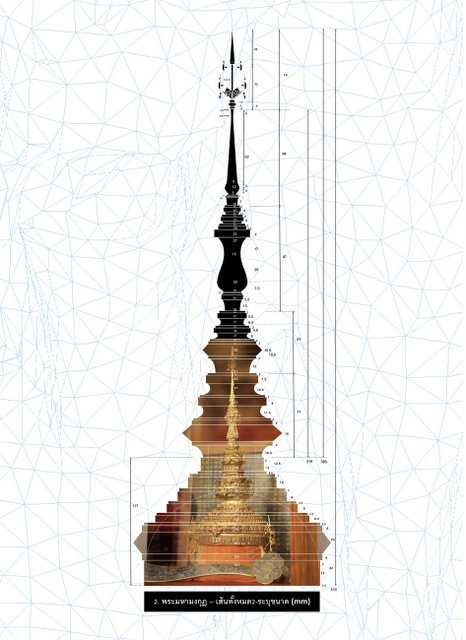

Mongkut by Arin Rungjang
Until May 17, 2015

Maison d’Art Bernard Anthonioz
16, rue Charles VII - Nogent-sur-Marne

Open to the public, weekdays from 1 pm to 6 pm, Saturdays and Sundays from 12 pm to 6 pm / closed on Tuesdays and public holidays
The tip: admission is free
_
Amédée de la Patellière, les Éclats de l’ombre (Shards of Shadow) at the Mudo-Musée de l’Oise
After several years of work, the Mudo-Musée de l’Oise is reopening its doors to offer us a wonderful exhibition on a little-known French painter, presented in the entrance gatehouse and the 18th-century wing. This painter is Amédée de la Patellière.
 Amédée de La Patellière was born in 1890 in the Nantes region. He had barely begun his career when the First World War broke out. The young man was part of this sacrificed generation; he would not be demobilized until 1919 and would die of septicemia in 1932, likely as a result of a poorly treated war wound. On the front, the painter never showed combat directly.
The soldiers are represented during their moments of pause, often from behind, for example, when playing cards. The ravages of the first world conflict are, however, visible in his very touching watercolors of dead trees, mutilated by shells. The violence, which the painter keeps at a distance, emerges in the softness of these washed-out shades.
After the war, Amédée de La Patellière returned to the large compositions he had begun to explore. Highly structured, his paintings mix realistic and geometric elements—under the influence of the Cubists.
The painter rediscovered nature, which he cherished so much. His personal palette is composed of browns and a beautiful emerald green that would become increasingly dominant. A cow here, a horse there… animals are very present in his paintings, a testament to the artist’s proximity (who was also a horseman) to animals.
 In 1928, Amédée de La Patellière painted “Bathers in Bandol”. The subject was in vogue; it was the era of seaside holidays.
The emerald green so unique to his early works asserts itself masterfully in this composition made of horizontal planes. The bathers sink into the water, and you wish you could join them.
 However, Amédée de La Patellière was not just an earthy painter. Oneirism runs through some of his works. “The Conversation in the Studio”, a 1927 work, reveals a strange, almost unsettling scene.
It is indeed a strange conversation that the painter depicts, as the three women standing out against a deep red are silent. The colors are muted. Light is nevertheless present, reflected by the women’s jewelry, rings, and earrings.
 Throughout his career, Amédée de La Patellière painted few self-portraits. Is “The Philosopher with the Bottle” a representation of himself in disguise? In any case, that is what his friend Giono, for whom Amédée de La Patellière had illustrated his first novel, “Hill” (Colline), claimed.
We do not know if the character with the face masked by a hat is asleep… The owl, for its part, seems to be watching over the scene. By looking at the painting intensely, one feels transported beyond the scene depicted. “Painting is the art of moving nature to the spiritual plane, using only plastic means,” the artist said. This is exactly what we feel.
 Amédée de La Patellière, an independent painter who carved his own path throughout his career, opens a window onto another dimension and takes us with him into a distant place, with his animals, far from the noise and fury of war, to calmness.
After the exhibition on Amédée de La Patellière, it would be a shame not to climb to the museum’s attic to discover “Axis Mundi”, a work by Charles Sandison, a British visual artist. The space is enough to tickle creative inspiration: 500 square meters of space under a 16th-century framework with nearly 15 meters of height.
In the space plunged into darkness, we discover moving words, projected onto the floor, the beams, and the walls by 16 computers. These words are related to the history of the palace and the museum. For example, there is a 15th-century poem by Jehan Regnier, who was held captive awaiting ransom in the Beauvisage tower of the episcopal palace and who wrote poems compiled under the title “Fortunes et adversités”.
With his work, Charles Sandison reveals fragments of memory of this place steeped in history, a part of its mental image. In religion, the axis mundi is the axis around which the world rotates, the cosmic axis, but also the connection between Heaven and Earth.
With “Axis Mundi”, the museum attic becomes a bridge between two worlds, a link between the terrestrial and spiritual dimensions, a brilliant and sensory demonstration that culture, if one still doubted it, elevates our souls.


The museum also offers a very interesting permanent collection, with a 19th-century collection. Alfred Sisley, Corot, and Ingres await you in particular, as well as “The Enlistment of Volunteers” by Thomas Couture, the largest canvas in the museum, initially intended to decorate the National Assembly.
Note: a tactile table composed of several applications (puzzle, timeline, etc.) allows visitors of all ages to extend their visit. The 20th-century collection should open to the public in a few years.

Amédée de la Patellière, les Éclats de l’ombre
Until June 30, 2015

Axis Mundi by Charles Sandison
Until September 30, 2015

Mudo-Musée de l'Oise
Beauvais

Every day from 11 am to 6 pm except Tuesday and some public holidays: Easter Monday,
Friday May 1st, Whit Monday, Wednesday November 11th
The tip: admission is free and it is an opportunity to discover, a stone's throw from
the museum, the Beauvais Cathedral
Getting to the museum by car
Located 1 hour from Paris, the MUDO - Musée de l'Oise benefits from major roads connecting to the capital via the A16 or RN1, Amiens via the A16, Rouen via the RN31, or Lille via the A16 and A1

Getting to the museum by public transport
 The train station is a 15-minute walk from the museum by crossing the city center

Bus lines serve the center, and taxis are stationed near the station
Lines 2-3-4-5-6-9: cathedral stop
_
Another Dream by Ken and Julia Yonetani at the Abbaye de Maubuisson
Maubuisson is no ordinary place. It is originally a Cistercian abbey for women, founded in 1236 by Blanche of Castile. In 1793, after the Revolution, the site was emptied following its sale as national property. In the 19th century, it was used as a stone quarry.
Result: three-quarters of the buildings were dismantled. Purchased by the Val d’Oise General Council, the site has been hosting two monographic exhibitions per year since 2004. Leading this small, very dynamic team: Isabelle Gabach, who is enthusiastic about the work of two Tokyo-born artists, Ken and Julia Yonetani. She contacted them, they discovered the site, and the attraction was mutual.
The stone-built site, steeped in history, with high ceilings and ribbed vaults, is the ideal setting for a fairy tale. But the story Ken and Julia Yonetani tell us, even if their images are beautiful, is chilling.
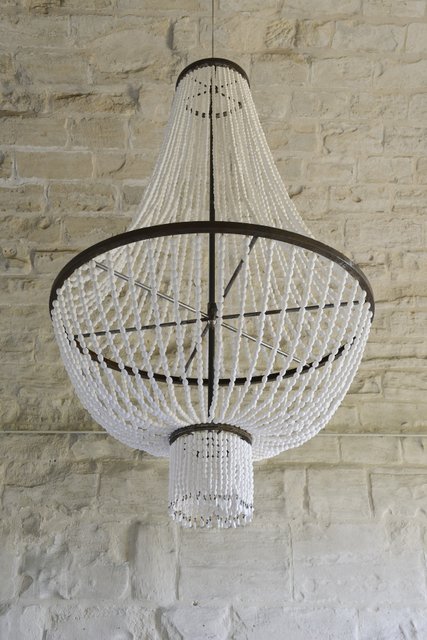
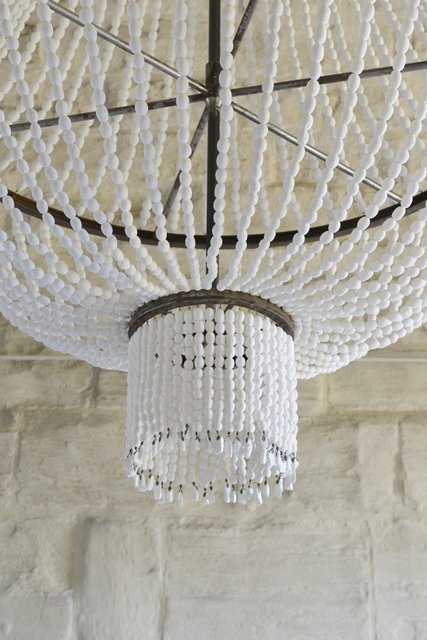
A sumptuous chandelier welcomes visitors in the entrance hall… “Grape Chandelier” is made of more than 5,000 grape seeds in salt. In 2010, the Japanese duo undertook a residency in an Australian agricultural region facing soil salinity due to excessive irrigation.
It is to highlight this ecological problem that the two artists have been making salt sculptures ever since. The technique is refined: it involves three different types of salt, compacted in silicone molds. So, while the grape seeds of the chandelier are beautiful, they are absolutely inedible. The harvest is indeed bitter… Will the Yonetani chandelier be able to shed light on our situation and bring humanity back to its senses?
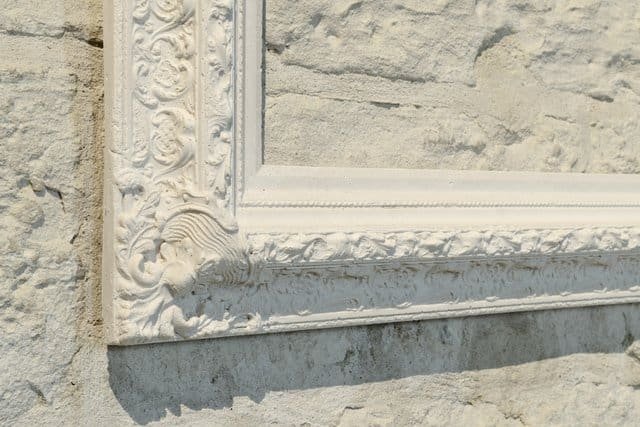 In the Parlor room, the artists have hung five salt frames on the walls, created using the same technique as the chandelier. “The Five Senses” refers to the “Allegories of the Five Senses”, a series of five paintings representing the female personifications of the senses, painted by Jan Brueghel the Elder and Peter Paul Rubens in 1617 and 1618.
One can first see a nod from the Japanese artist duo to two other artists who collaborated in their time. But here, the frames frame nothing. The five senses have disappeared. Only a void remains, perhaps created by the salt itself, which ravages everything. To fill this void, we can call upon our sixth sense, imagination, but it is a meager consolation.
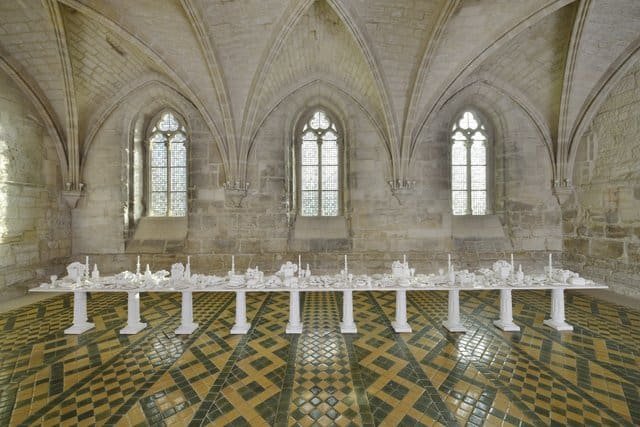
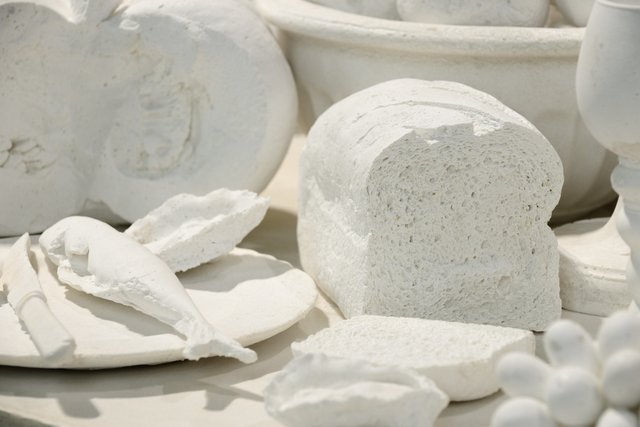
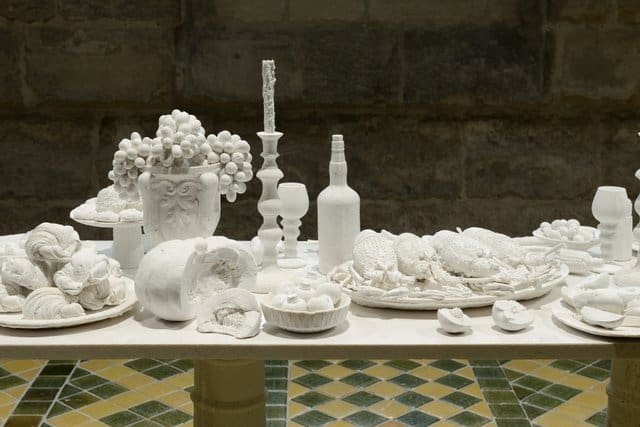
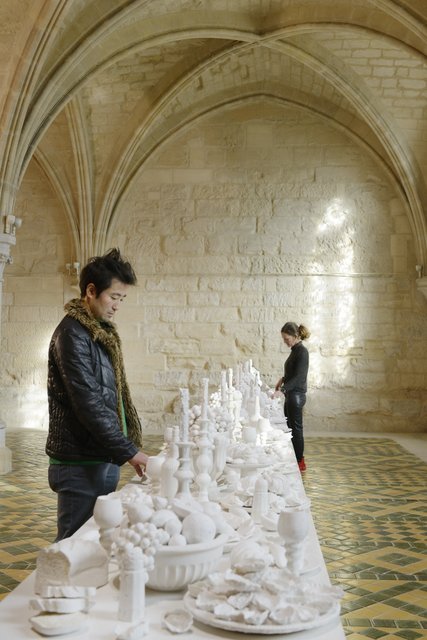
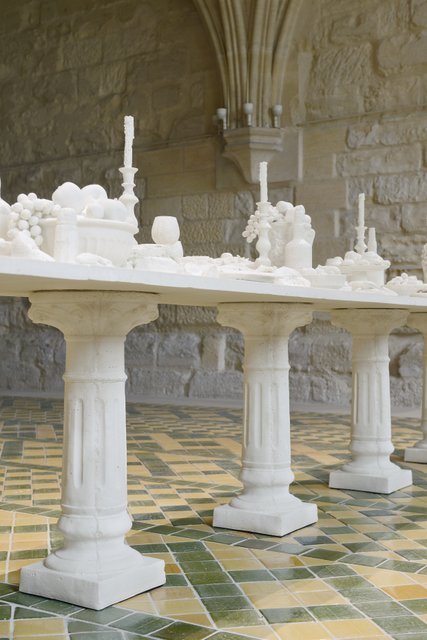
With “The Last Supper”, produced for the Chapter House, Ken and Julia Yonetani invite us to a strange banquet. The reference to art history and particularly to Leonardo da Vinci’s The Last Supper is direct. On the long salt table, a feast unfolds, also made of salt: salt shakers (13, the number is not insignificant), bread, grapes, oysters, croissants…
We are first struck by the beauty of the sculpture, but the fascination soon gives way to discomfort. The profusion becomes unsettling, as much as the whiteness of the food, accentuated by artificial light. This food is no longer natural; it has lost its flavor.
With this work, the artists question our consumer and waste society. One also thinks of Chernobyl, of Fukushima. The Yonetani banquet could well prefigure the “last meal” that will be served to humanity before its disappearance.


 In the Nuns’ room, “Crystal Palace” awaits us, named after the grandiose glass building designed for the 1851 London World’s Fair, which burned down in 1936. The room is plunged into darkness. Fluorescent chandeliers are hung from the ceiling. The impression is striking. Each chandelier, made of uranium beads, represents a nation that produces electricity from nuclear power. The greater its production, the larger the chandelier. France is well-ranked.
Ken and Julia Yonetani deliver here a very personal illustration of humanity’s headlong rush, little concerned with the long term, and foreshadow a sinister end, as the work’s title suggests.

 “Three wishes” does nothing to reassure us. It is a small music box that plays “It’s a Small World,” composed for the Children of the World Pavilion. It is an attraction created by Disney with UNICEF in 1964 for the New York World’s Fair. At the time, the atom was seen as a clean and safe source of energy.
A few years earlier, Disney had even touted its merits in a book titled “Our Friend the Atom”. A nice fable for small children… The inside of the music box contains a small female character, a kind of Tinker Bell.
But here’s the catch: the wings of this fairy are actually those of a taxidermied butterfly whose egg was collected not far from Fukushima, as part of a scientific study. This study showed that irradiated butterflies exhibited malformations and genetic mutations. The little post-atomic fairy has taken a hit… Through this tiny work, Ken and Julia Yonetani highlight the ravages that nuclear power can cause.
Irony or omen, the vision of humanity proposed by Ken and Julia Yonetani ends in the former latrines of the abbey. A chandelier is presented there, the one for Japan, since after the Fukushima accident, the Japanese government had shut down all nuclear reactors.
“Another Dream” by the Yonetani duo unfolds a nightmare punctuated with images all more beautiful than the last. A nightmare that man is the author of and from which one would like to wake up, but it may be too late…
Another Dream
Until August 30, 2015

Abbaye de Maubuisson
Contemporary Art Site of the Val d'Oise General Council
Avenue Richard de Tour
95310 Saint-Ouen l’Aumône
_
Le Pressionnisme (Pressure-ism) at the Pinacothèque de Paris
Pressure-ism? Yes, you read that right. Nothing to do with Impressionism, even if the similarity in sound is not insignificant. It is a much more recent artistic movement, that of graffiti art, born forty years ago in the United States. The “pressure” is that of the aerosol can. The exhibition presents nearly a hundred works, created essentially on canvas, between the 1970s and 1990s.
The movement was born in the United States where, as early as 1972, graffiti artists banded together to create in studios and exhibit their works in galleries. The first protagonists included Coco and Phase 2, with graffiti artists always taking a nickname, or even several, during their career.
This is one of the merits of the exhibition: teaching us that these artists left the street very early, to which we still tend to equate them today, associated with each other and never stopped dialoguing, measuring themselves, and sometimes even creating collective works during the history of the movement.
 Graffiti is a colored surface surrounded by a line, not to be confused with a tag, which is simply the artist’s signature in black line. Color is obtained by the aerosol can, which is more difficult to master than it seems, as it takes several years of practice to compose with this urban brush.
Four parameters come into play: distance, speed, inclination of the can, and pressure. The mastery of the gesture of Phase 2 only leaves one dreaming. A major difference from traditional painting: the impossibility of mixing colors. They are not mixed, but juxtaposed.

 The exhibition illustrates the evolution of the movement. Little by little, we witness a complexification of lettering. Several schools develop. Tracy invents the Wild Style, where the letters merge and tend to approach abstraction.
Great names passed through there: Andy Warhol in particular, who “brought out” Basquiat and Keith Haring from graffiti. Only one woman is present in the exhibition: Lady Pink, with a very figurative style. We are disappointed to find only one work of hers exhibited.
 In the 80s, Bando, a French-American, imported the practice of graffiti to France and invited American and European artists to work together. Collaboration, collective work, emulation… the movement took on the same dynamics as in the United States. The first French school emerged.
Fashion designers, led by Agnès B., became interested in it and offered them additional visibility. The designer even lends three works to this exhibition. The preliminary sketches exhibited show that the works are the result of mature work and are not spontaneous at all, as some might believe.


The exhibition reminds us that this movement, which the general public continues to consider recent, is already old and has long been exhibited in museums and galleries. The first official American exhibition dates back to 1980, the European one, in the Netherlands, to 1983.
The visitor is therefore not witnessing the beginnings of a movement, but the beginning of the writing of its history – in France at least. Between collectors’ enthusiasm and storytelling, the movement, now endowed with a respectable name, does not wait for full and entire recognition from the institution to make its place.
Exhibition Le Pressionnisme, les chefs-d’oeuvre du graffiti sur toile
Until September 13, 2015

La Pinacothèque de Paris
28, place de la Madeleine - 75008 Paris

Full price: €13 - Reduced price €11
Reduced price: young people from 12 to 25 years old, students, job seekers, Maison des Artistes,
tour guides, Pinacopass companion
Free: children under 12 years old, disability card holders, companion of a disabled person, RSA, ASS, ASPA beneficiaries, tour guides and teachers with group reservation, journalists, ICOM
_
The Chromatic Festival in Paris
 This Montreal festival arrives for the first time in Paris at the Cité de la Mode et du Design from April 2 to 4, 2015.
For 3 days, this multidisciplinary festival brings together more than a hundred contemporary artists who present their works around the “Colors” theme. Furthermore, a series of concerts will also take place during the Nuit Chromatic on Thursday, April 2, and the public will be able to try screen printing or even get a tattoo.
The festival is structured around three highlights:
- La Nuit Chromatic: an unmissable Art Party that brings together the new Montreal and Parisian music scene for exceptional concerts, with the presence of tattoo artists and screen printing workshops.
- The Block Party Chromatic: a musical event aimed at promoting urban art with eight hours of music, live street art, and monumental photography.
- The Piknic Électronik Paris and Puces Chromatic: the Piknic Électronik settles in Paris for the first time, within Chromatic! Electronic music, workshops, screen printing, and a graphic market offered by the Campus de la Fonderie de l’Image to explore with the family.


Cité de la Mode et du Design
34 Quai d'Austerlitz, 75013 Paris

from April 2 to 4, 2015
_
article written by Sandrine and Melle Bon Plan