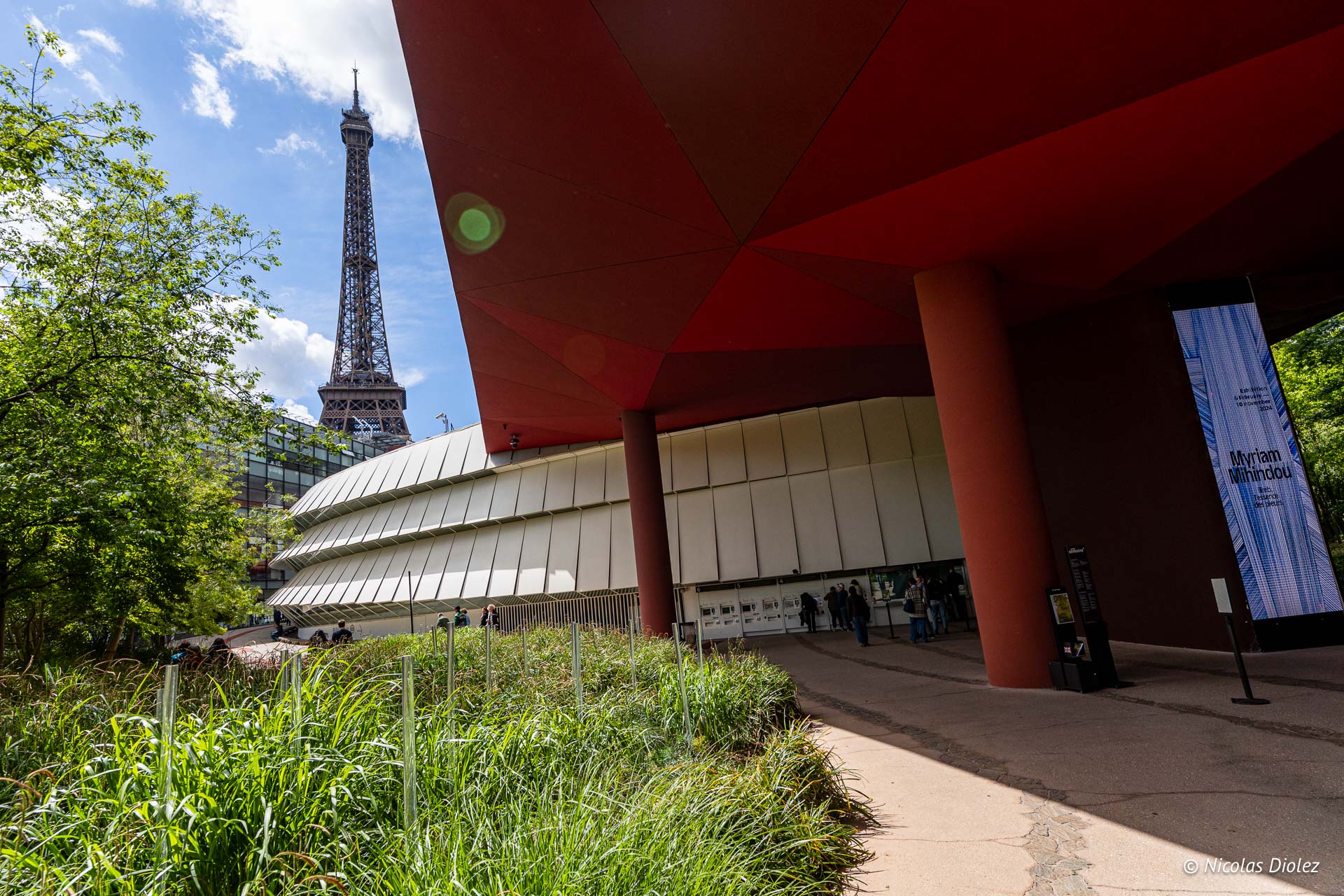
This month, we are going to meet the masters of Ivory Coast sculpture at the Quai Branly Museum. From there, we head to the house of Victor Hugo for an exhibition focused on the wonderful drawings of the great French writer and those of a Swiss artist. Next, we will take you to one of our favorite Parisian museums to discover theater in Asia, followed by a free photo exhibition at Bercy Village.
Then we will leave Paris for the very pretty town of Montbéliard, which is honoring a little-known French painter famous for his sumptuous nudes. We will also suggest a short visit to a royal abbey in the Baie de Somme that is hosting a rich and exciting exhibition about animals. Finally, back in the Ile-de-France region, we will stroll in the footsteps of Van Gogh in Auvers-sur-Oise.

The masters of Ivory Coast sculpture at the Branly Museum
(by Sandrine)
The approach is unprecedented: to show, through a broad panorama of sculptures from Ivory Coast, the uniqueness of their creator. Without hiding the often sacred dimension of most of the objects presented, the exhibition reminds us that African art, just like Western art, is the work of full-fledged artists.


Most of the pieces presented are made of wood. They come from different regions of Ivory Coast and date from the 19th century and the beginning of the 20th century. The visitor sets off to meet the sculptors grouped by region. These sculptors left behind their artist name: the Master of the rooster comb hairstyle, the Master of rounded volumes, the Master of shovel-shaped hands… You realize when facing the display cases that each artist effectively possesses their own unique touch.
We also discover the Master of ivory sculptures, creator around 1900 of ivory fly-whisk handles. Enough to leave one dreaming…
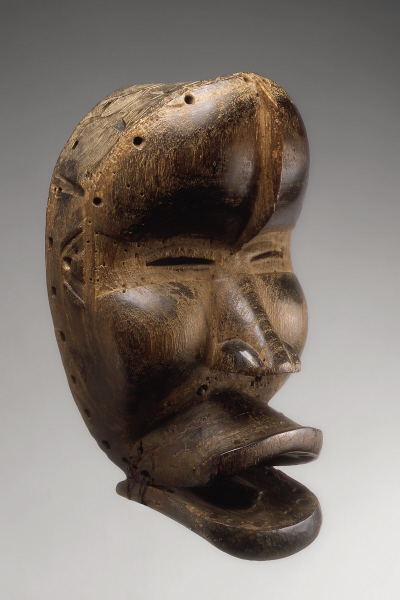

In Africa, artistic practice was by no means a trivial act. As Lorenz Homberger, co-curator of the exhibition, points out, artists worked “in the sacred forest, sheltered from the eyes of women and the uninitiated. Most of the time, in fact, the creation of masks was accompanied by prohibitions, shrouded in taboos.”
So what was the status of these creators? “Even if we cannot speak uniformly for all the regions that make up Ivory Coast, it is clear that some of them enjoyed a very privileged status. Among the Dan, the sculptor Sra was thus considered a god in his own right, and his reputation reached well beyond his village.”, continues Lorenz Homberger.


My preference goes to the Baoulé sculptors, who remain the most renowned in the country. Ornate wooden objects, or even gold-plated ones, are still signs of prestige today. Among the Baoulé sculptors presented, one can admire the works of the so-called “Master of Kamer”: masks surrounded by a finely serrated border, a testament to formidable craftsmanship.
Long confined to anonymity by Western art history, these masters of sculpture find in this exhibition the beginnings of recognition for their personal artistic expertise.
Table of Contents
Exhibition The masters of Ivory Coast sculpture
Until July 26, 2015
Branly Museum
Temporary exhibitions of the Jardin gallery: full price €9 / reduced price €7
free: the first Sunday of each month for everyone, for job seekers and welfare recipients, for those under 18
_
Louis Soutter – Victor Hugo Parallel Drawings
at the Maison de Victor Hugo
(by Sandrine)
The Maison de Victor Hugo, on the Place des Vosges, offers us a fabulous exhibition whose title keeps all its promises. “Louis Soutter – Victor Hugo Parallel Drawings” also has a double merit: reminding non-specialists to what extent the great French writer was a talented draftsman, and making us discover the unique figure of Louis Soutter, a Swiss artist placed at age 52 in a hospice for the elderly.
Louis Soutter was born in 1871; Victor Hugo died in 1885. Their drawings, conceived a hundred years apart, present astonishing resonances. First, there is this common taste for ink. Here brown and black dominate. The two men also share certain themes such as towers, castles, and medieval towns. Before studying the violin at the Royal Conservatory of Brussels, the young Louis Soutter had indeed first dedicated himself to architecture.
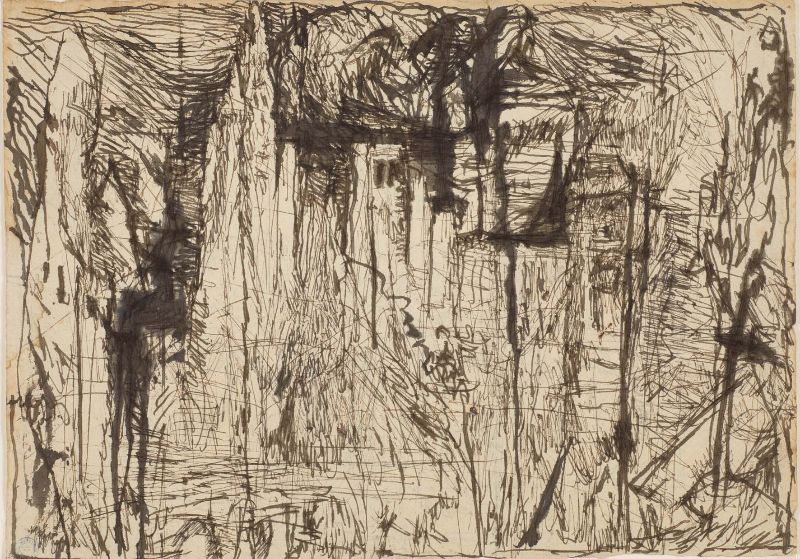
In his notebooks, the Swiss artist also explicitly mentions the imaginary architectures of Victor Hugo. The drawings of both artists are in fact re-creations of their travel memories recorded in notebooks. Neither one nor the other is about reproducing landscapes in a precise way.
The wash technique, used by Victor Hugo, is moreover better suited to the overflows of an undulating reverie than to the transcription of a precise and fixed reality. But it is also their own inner human condition, with all its darkness and shadows, that both artists project onto these facades.
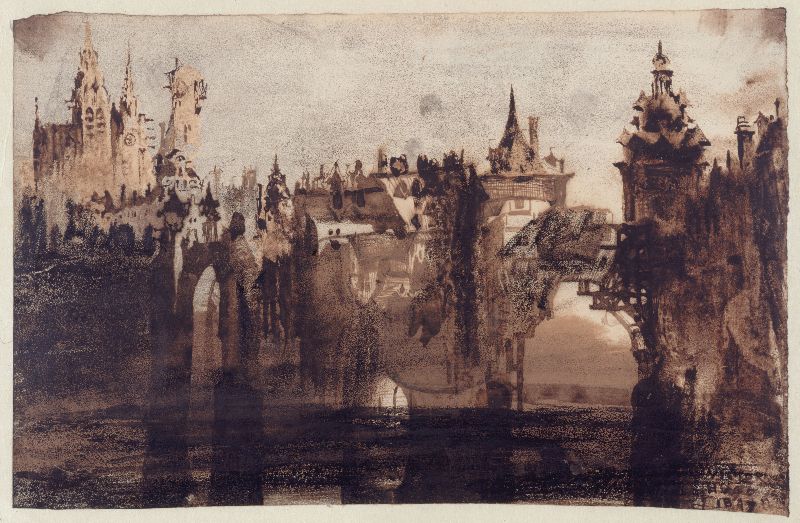
Victor Hugo and Louis Soutter also meet around the great human epics. In his collection of poems The Legend of the Centuries, Hugo depicts the history and evolution of Humanity through visions. Some of Soutter’s drawings are like an echo to this “wall of the centuries” contemplated by the poet. To Hugo’s Trumpet of Judgment respond Soutter’s Trumpets of Heaven.
“I saw in the cloud a monstrous bugle.And this bugle seemed, on the deep threshold of the heavens, calm, waiting for the immense breath of the archangel.”
(Victor Hugo – The Legend of the Centuries)
In 1937, Louis Soutter was 66 years old. He had been living for 14 years already in a hospice for the elderly. His hands were deformed by osteoarthritis. Unable to hold a pencil anymore, he used his fingers to draw. The suffering body intervenes directly on the paper and reveals itself. This is the period of the very moving “finger drawings” exhibited in the last room.


Victor Hugo also tried this method, but more through experimentation. The scenography of the exhibition makes the two artists talk directly to each other thanks to a beautiful idea: some of their works, placed at the same scale and back to back, overlap in transparency. Two artists with very different lives, whom a century separates, are thus reunited.
Exhibition Louis Soutter – Victor Hugo Parallel Drawings
Until August 30, 2015
Maison de Victor Hugo
6, place des Vosges 75004 Paris
Full price: €7 / Reduced price: €5
_
From Noh to Mata Hari, 2000 years of theater in Asia at the Guimet Museum
(by Sandrine)
Sweeping through two millennia of theatrical expression on the Asian continent, the exhibition does not lack ambition. The subject could be off-putting, as we know so little about this highly codified theater. But as Aurélie Samuel, co-curator, explains, the exhibition aims precisely to “provide the keys” to understand it, and possesses as formidable assets sumptuous pieces that immediately sweep us away.


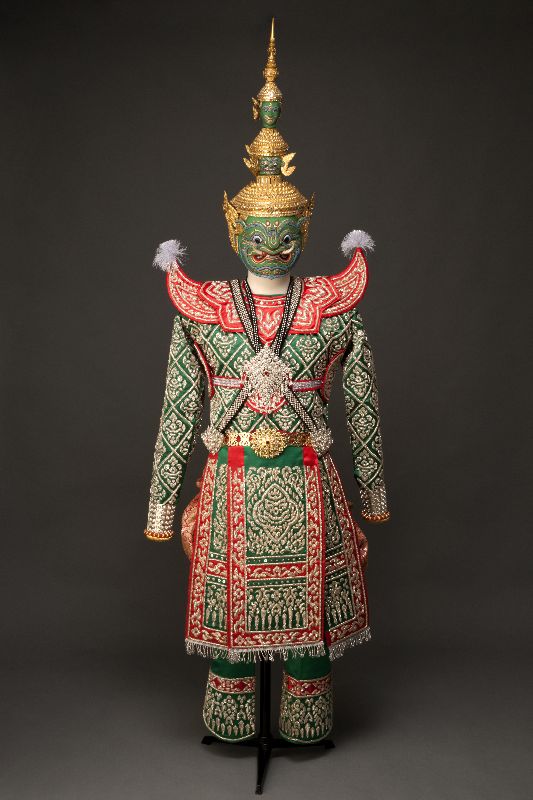
In Asia, theater is a complete art that mixes acting, mime, dance, song, and even acrobatics. The common denominator to all these theatrical art forms: the predominant place of masks and costumes that fill the absence of sets.
In India and Southeast Asia, theater is inspired by great epics. The costumes, which act as scenery, must be as voluminous as possible. Each color has a precise meaning. Thus, green is intended for heroes, red for demons.
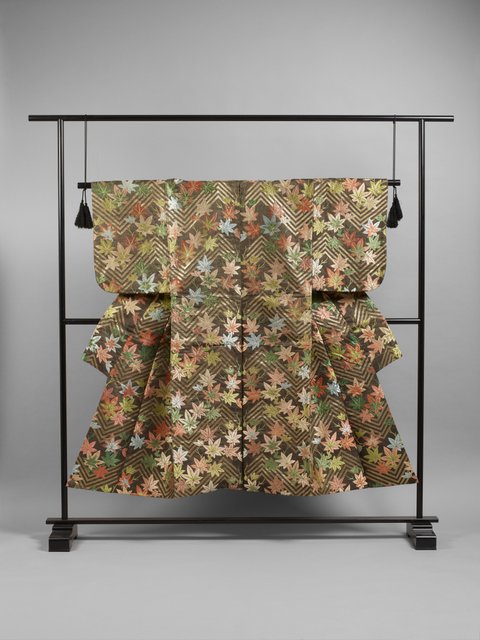
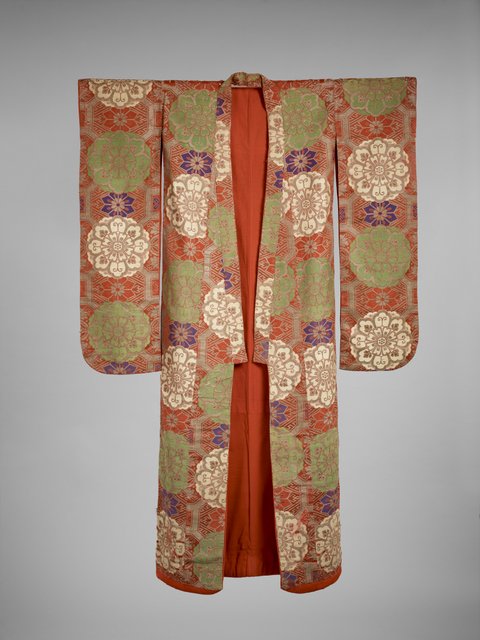


The exhibition obviously gives pride of place to China and Japan, where a purely dramatic entertainment theater developed. The very elaborate costumes have an essential role since they inform spectators about the nature and social status of the character, where they are, and the time of year.
Among the most beautiful pieces presented, one can admire the fabulous costumes of the Beijing Opera, saved from destruction. Under Mao, the Beijing Opera was banned, actors were massacred or sent to re-education camps, and many costumes were burned.


In Japan, two performing arts dominate: noh and kabuki. Noh is a classical, elitist theater, performed with masks smaller than the face and whose costumes can take five years to make. Kabuki is a joyful, popular theater, whose performances can take place over an entire day.
Far from being intended only for children, puppet and shadow theater occupies an important place in the exhibition. Articulated puppets, figurines cut from leather… the exhibition showcases a wide spectrum of this performing art in its own right.
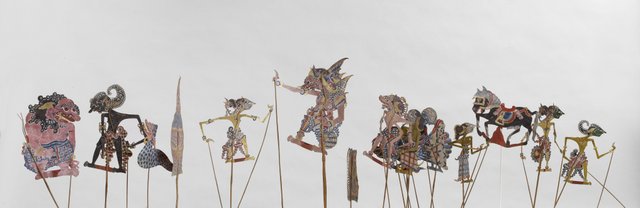 As for puppets, there were some on March 13, 1905 in the library of the Guimet Museum. That day, Émile Guimet, founder of the museum, invited Margaretha Zelle, a young Dutch woman who had returned from the East Indies, to come and perform some exotic dances, as well as to give a demonstration of wayang kulit puppets. Under a scientific guise, it was neither more nor less than to create buzz.
Appearing under the guise of a Javanese princess wearing very little clothing, the young woman danced, supposedly paying homage to the god Shiva. The spectators were inflamed; it was rumored that the pretty dancer had finished naked. That is false, but it doesn’t matter. It was a nice publicity stunt, both for the museum and for the dancer, whose stage name spread like wildfire: Mata Hari.
 On the sidelines of the exhibition, the Guimet Museum offers a host of documentaries, shows, and meetings that allow for a better understanding of theater in Asia. I noted:
- Friday, June 5 and Saturday, June 6 at 8:30 PM: Melattur Bhagavata Mela
The Melattur Bhagavata Mela, one of the few surviving forms of temple theater, is the only current link that connects us to ancient Sanskrit theater in Tamil Nadu. Its tradition was born 400 years ago. Seventeen artists will be on stage for a performance very exceptionally played outside the temple grounds.

Exhibition From Noh to Mata Hari, 2000 years of theater in Asia
Until August 31, 2015
National Museum of Asian Arts – Guimet
6, place d’Iéna, 75116 Paris
Combined ticket for temporary exhibition and permanent collections:
Full price: €9.50 Reduced price: €7
Audio guide in 8 languages for permanent collections: free
Each first Sunday of the month, access to permanent collections is free (entry to temporary exhibitions remains paid)
_
Magnum Photos takes over Bercy Village
(by Melle Bon Plan)
Bercy Village is hosting the photography exhibition: “Magnum Photos, portrait stories,” in the covered passages of Bercy Village from June 4 to August 30.
One will be able to discover about twenty snapshots by three iconic photographers of the Magnum Photos agency, Philippe Halsman, Elliott Erwitt, and Bruce Gilden, accompanied by the forty most successful portraits made during the “Picture yourself” day.
Through these portraits, the three photographers open a window onto society from the 1950s to the early 2000s, often with a touch of humor.
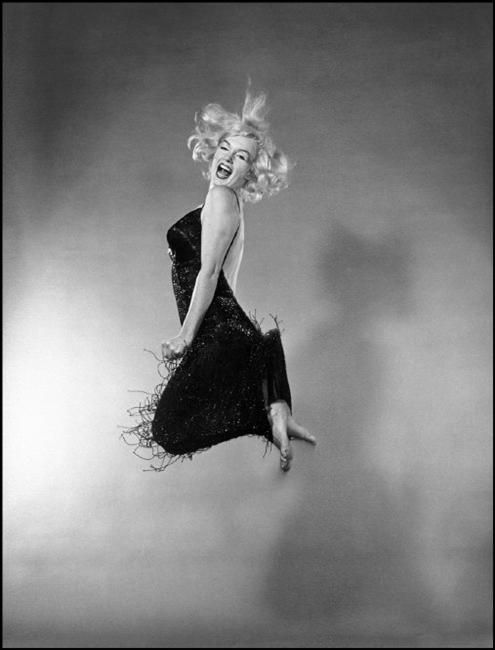

Exhibition “Magnum Photos, portrait stories”
Bercy Village, in the covered passages
from June 4 to August 30, 2015
free and open access
_
Albert André – Intimacy of a realist painter at the Museum of the Château des Ducs de Wurtemberg
(by Sandrine)
The Museum of the Château des Ducs de Wurtemberg, in Montbéliard, offers us the opportunity to discover the work of Albert André, a French painter who has somewhat fallen into oblivion (1869-1954). Titled “Intimacy of a realist painter,” the exhibition is focused on interior scenes and the painter’s life, with nudes that I really liked.
Originally from Lyon, Albert André was initiated into drawing very early. Quickly, the young man moved to Paris, where he enrolled at the Académie Julian, a private school of painting and sculpture. There, he frequented young rebel painters who would become famous under the name of Nabis, notably Bonnard, Vuillard, and Vallotton, whom he drew strong inspiration from in his beginnings. Unprecedented, very photographic framings, pure color “straight from the tube” of paint, “japonism”… so many ways for the Nabis to escape academicism and claim their independence.


In 1895, the young Albert André participated in the Salon des Indépendants with five paintings that caught the eye of Auguste Renoir and that of his art dealer, Paul-Durand Ruel. Despite the age gap between Albert André and Renoir, a solid friendship would unite them until the death of the master of Impressionism in 1919.
This meeting would guide the career and life of Albert André, who would participate in 200 exhibitions during his lifetime, including 50 organized by Durand-Ruel. Through him, Albert André would sell a lot in the United States: the majority of his 3,500 paintings and drawings are there today.
In Paris, Albert André made the acquaintance of the Parisian artistic scene. His paintings are an opportunity to plunge back into the atmosphere of the vernissages of the time, such as that of the Manet exhibition. The artist also represented the bourgeois women frequenting the intellectual scene of the time.
 Albert André’s wife, Margueritte Cornillac, known as Maleck, was a decorator. She counted among her clients Jeanne Bourgeois, known as Mistinguett, and the Moulin-Rouge. The couple, settled on Boulevard Rochechouart, received composers, art critics, and painters such as Monet and Pissaro.
 Maleck hired a young woman born in 1904 in Belfort, Jacqueline Brétégnier, to make theater costumes. Jacqueline would finally remain thirty years by the couple’s side, becoming Albert André’s muse. We discover her throughout his career, in scenes of daily life, posing tirelessly.
Gradually, Albert André developed his own style. He returned to volumes, perspective, and focused on realism. He took an interest in interiors with a contemplative gaze, represented women with averted eyes, and focused particularly on nudes, always modest. In his women taking off their stockings, we notably recognize the influence of Degas and Toulouse-Lautrec. His nudes, very beautiful, would accompany him all his life.


This intimacy revealed by the exhibition also showcases the friendship between Albert André and Renoir, which began in 1895 when Renoir noticed him at the Salon des Indépendants. From then on, they would see each other very often. They had incessant exchanges, nourished correspondence. Renoir, who suffered from rheumatism, settled with his family in 1903 in Cagnes-sur-Mer, the region’s climate being supposed to be more favorable to his health.
Albert André visited him, then becoming, as Renoir called him, his “companion of solitude”. Renoir chose Albert André to be the godfather of his third son. And he encouraged him to accept the position of curator of the museum of Bagnols-sur-Cèze: “It was the dream of my life, accept.” Albert André became the curator of this museum in 1918. Renoir offered him paintings and drawings; Vallotton, Pissaro, Signac, among others, did the same. The museum of Bagnols-sur-Cèze became the first provincial museum of contemporary art.
 Albert André set to work writing the biography of Renoir, the only one written during his lifetime, which appeared in 1919. From Cagnes, Renoir thanked Albert André for his preface: “In reading your preface I saw only one thing, it is written with friendship. Not everyone can say the same. You see me through pink and golden vapors but you see me like that.” (Sources: http://www.germaindion.com/2015/03/21/renoir-par-lui-meme/
http://www.grandpalais.fr/sites/default/files/spip/1916.pdf).


Albert and Maleck André did not have children. In 1946, they adopted Jacqueline Brétégnier who became Jacqueline André. It was a way to preserve Albert André’s work and prevent it from being dispersed. Albert André died in 1954.
Jacqueline André then became curator of the Bagnols-sur-Cèze museum. She used to say of him: “I owe everything to Albert André and that is why everything must return to him.” A painter herself under the artist name Jacqueline Bret-André, she became part of the family tradition and strove all her life to preserve and make known the work of the man who had immortalized her so many times in his paintings. Immortal, she almost was, since she lived to the age of 101.
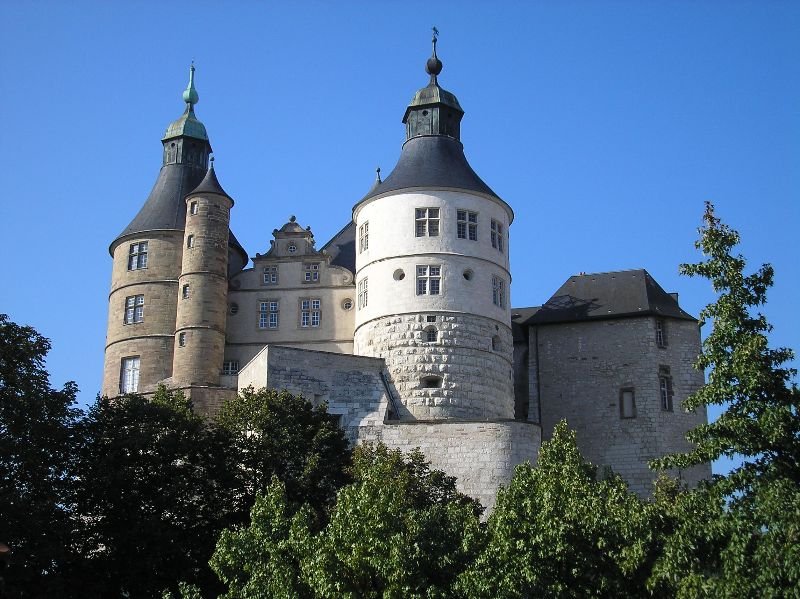
The
Château des Ducs de Wurtemberg reminds us that Montbéliard has only been French since 1793. To learn more about this Protestant town, head to the Hôtel Beurnier-Rossel, built in the 18th century, which houses the Museum of Art and History.
The first floor hosts the reconstruction of a bourgeois interior. One can admire furniture richly inlaid by the famous Montbéliard cabinetmaker Abraham-Nicolas Couleru. The second floor is dedicated to the history of the traditions of the Montbéliard region.


One discovers there a pile of fascinating objects that show regional particularities: diairi bonnets (local headdress) that women adorned themselves with, but also Lutheran goldsmithing. The attic houses an astonishing collection of music boxes manufactured by the L’Épée factory in Sainte-Suzanne, a small village located next to Montbéliard.
Good to know: Montbéliard is only 2.5 hours by TGV from Paris!

Exhibition Albert André – Intimacy of a realist painter
Until September 27, 2015
Museum of the Château des Ducs de Wurtemberg – Montbéliard
From 10 AM to 12 PM and from 2 PM to 6 PM – Closed on Tuesdays, and May 1st
Entry: 5 euros / Group and student rate: 3 euros
Free entry for those under 12, disabled people, as well as the 1st Sunday of each month
Museum of Art and History – Hôtel Beurnier-Rossel
High season (July 1st to the 3rd weekend of September (Heritage Days), Christmas market period), Wednesday to Sunday: 2 PM – 6 PM
Low season every Saturday and Sunday: 2 PM – 6 PM
Full price: €3 / Reduced price: €2
Free entry for those under 12, disabled people, as well as the 1st Sunday of each month
_
Anima / Animal at the Royal Abbey of Saint-Riquier
(by Sandrine)
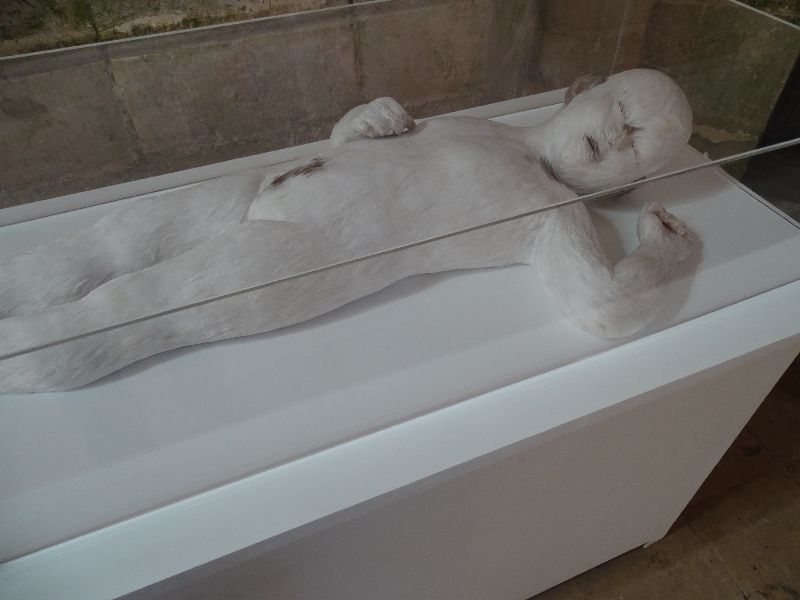
From afar, it looks like the effigy of a child in white marble. Getting closer, one discovers a hybrid creature, of human form, covered in white feathers. This striking work by Lucy Glendinning presented in the abbey church of Saint-Riquier is part of the Anima Animal exhibition.
As its lead curator, Evelyne Artaud, explains, the work is an invitation to continue the visit through the vast exhibition space and gardens of this royal abbey founded in 625, labeled as a Centre Culturel de Rencontre since 2012.
Questioning the place of the animal at the beginning of the 21st century in our lives and our imaginations is the theme of this exhibition, which brings together about fifty works by 29 contemporary artists of various nationalities, some of whom worked on-site in residency.


While each artist obviously proposes a singular point of view, and while the animal is not necessarily the central subject of their work, one is nevertheless struck by the absence of the “real” animal, in the wild, which no longer survives except in the imagination, replaced by the tamed and submissive animal.
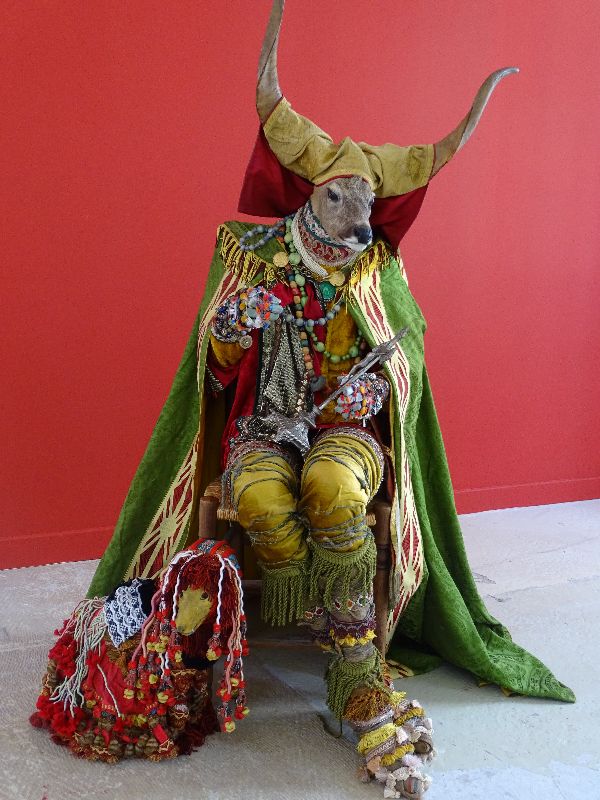
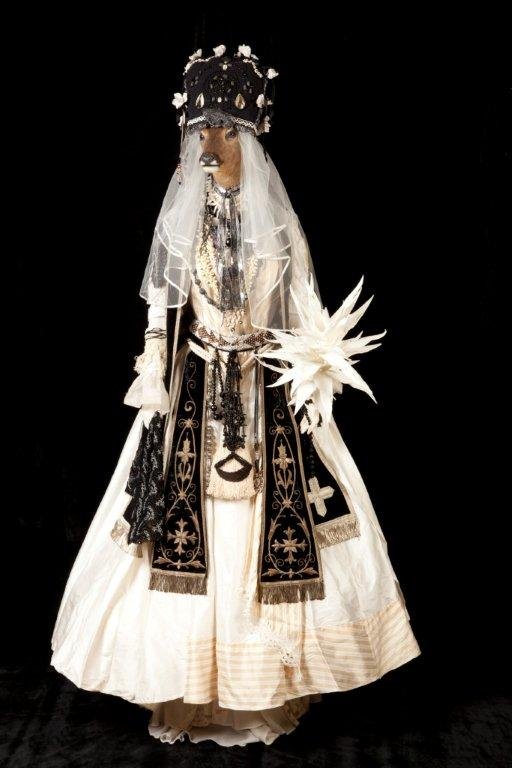
The mythical, fantasized animal continues to strongly fuel the imagination of humans and, as we see in this exhibition, of artists. Since the dawn of time, humans have represented other animals, to which they sometimes confer supernatural powers. From this imagination arise hybrid creatures which, far from necessarily being monstrous, weave a link between “them” and “us.”
Thus, the British artist Lucy Glendinning creates beings of human form covered in feathers from which paradoxically emerges a very great humanity and for which one feels great empathy. Benoit Huot for his part produces hybrids from stuffed animals, sorts of shimmering totems with magical powers.
What emerges from the exhibition is the absence of the wild animal or the representation precisely of this disappearance. It is true that the natural habitat of many species has shrunk like shagreen and that we urbanites, for the most part, no longer have much opportunity to rub shoulders with wild animals in freedom.
In Anima/animal, the works show an animal that is tamed, domesticated, or in danger of extinction. For example, we discover or rediscover on video the wonderful work of the dancer-choreographer and amateur ornithologist Luc Petton, who makes his troupe dance with tame birds.
 Born into a family of Palestinian refugees, Sharif Waked tells us the story of a donkey in the Gaza zoo painted as a zebra, ridiculed to please visitors craving stripes, a metaphor for the condition of Palestinians in Gaza.
In Virtual Ark, Ilias Poulos, whose work questions fragmentary memory, one can see endangered animals and populations, placed on the same level.
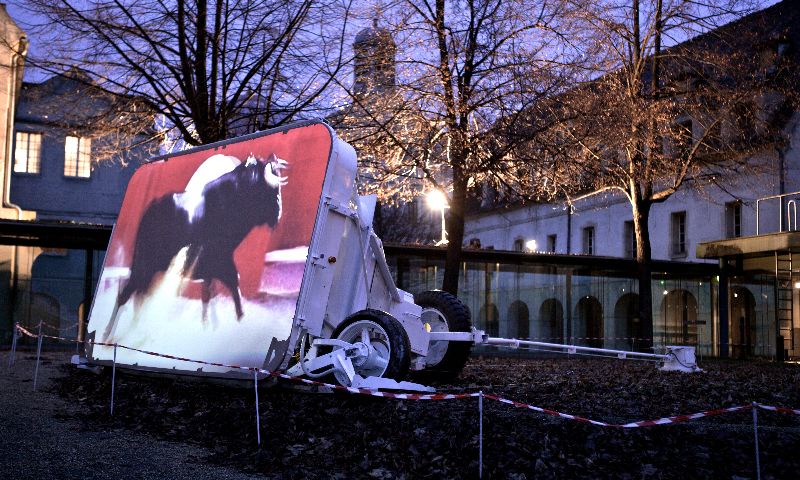
Leaving the exhibition space for the abbey gardens, one discovers a complex interactive device composed of a screen mounted on wheels representing a bull. In this multimedia work by Pascal Bauer titled The Circle, it is indeed the machine that tames and sets the animal in motion, which must adapt to its environment.
I confess, I would have liked to stay longer trying to understand everything about the ingenious device, but time was short…

 Several times, birds are presented in a dematerialized, fragmentary form. This is the case of the column of gull feathers that forms Berenice’s Hair: Curiosity by Isa Barbier, a poetic work whose verticality responds to that of the abbey’s exterior architecture.
Elsewhere, the bird is reduced to sounds, as in the Venus with Hinges, an interactive installation by Jacopo Baboni Schilingi around a statue by Arman. By opening and closing the hinges equipped with motion sensors, the visitor, invited to touch the work, varies the music conceived by the Italian composer, here from bird sounds.
 Our contemporary relationship with animals is perhaps best described by a photographic work by the Algerian artist Nourredine Ferroukhi: one sees a sheep slaughtered and then skinned. The animal is intended to be consumed. And in modern cities, it is mostly encountered under cellophane, in supermarkets. Anima/Animal… by losing the animal, are we losing our soul?
On the way back to Paris, along the road with roadsides littered with plastic waste, no trace of ruminants grazing in the fields on this spring day, just the fleeting silhouette of a rabbit glimpsed in the distance. Indeed, the animal is disappearing from our radars.
Note that on the sidelines of the exhibition, a creation by choreographer Luc Petton and writer Pascal Quignard, the fruit of a residency at the Abbey, will be proposed next autumn. It will be an opportunity to pay homage to Nithard, grandson of Charlemagne, lay abbot of Saint-Riquier, soldier, chronicler, and first writer of the French language. The moment promises to be magical.
Exhibition Anima / Animal
Until December 31, 2015
Royal Abbey of Saint-Riquier
80135 Saint-Riquier
Open every day from 10 AM to 7 PM (and from 10 AM to 9 PM during the Festival)
Full price: €4 / Reduced price: €3
Free access: holders of a subscription for festival concerts, students, university students and plastic arts teachers as well as those under 16
Access:
Saint-Riquier is located 10 km from Abbeville and 25 km from the Baie de Somme
Abbeville is 2 hours from Paris by the highway
Abbeville is 1 hour 30 minutes from Paris (Paris-Calais line) and 30 minutes from Amiens
_
In the footsteps of Van Gogh in Auvers-sur-Oise
(by Melle Bon Plan)
 I had already spoken to you about it last year, but today I am presenting the new cultural season of Auvers-sur-Oise which will be held this year from April 5 to August 31, 2015, and which will be dedicated, once again, to Vincent Van Gogh.
The goal of this cultural season is to attract tourists, but also Parisians to this beautiful town and this “gravely beautiful countryside” as Vincent said.
To discover all the beautiful visits you can make during a short day in Auvers-sur-Oise, I invite you to take a look at the article that I wrote last year and which I have updated to give you all the keys to get to Auvers-sur-Oise and, above all, to make you want to go for a tour in this beautiful village steeped in history.
article written by Sandrine and Melle Bon Plan